Finding a HUD foreclosure near you doesn’t have to be complicated. Whether you’re looking for your first home, searching for an affordable property, or exploring real estate investment opportunities, knowing where to find legitimate listings is the first step.
HUD homes are properties acquired by the U.S. Department of Housing and Urban Development following foreclosure on certain FHA-insured mortgages. These homes are offered for sale through an official government sales process.
The good news is that you don’t have to search blindly or rely entirely on third-party websites. You can start with HUD’s official property listing website, narrow your search by location, and review individual properties before deciding whether to make an offer.
In this guide, you’ll learn how to find HUD foreclosures near you, search by state or ZIP code, evaluate listings, and take the next steps toward buying a HUD home.
Where Can You Find HUD Foreclosures Near You?
Find HUD Homes by State
Select your state to begin your HUD home search.
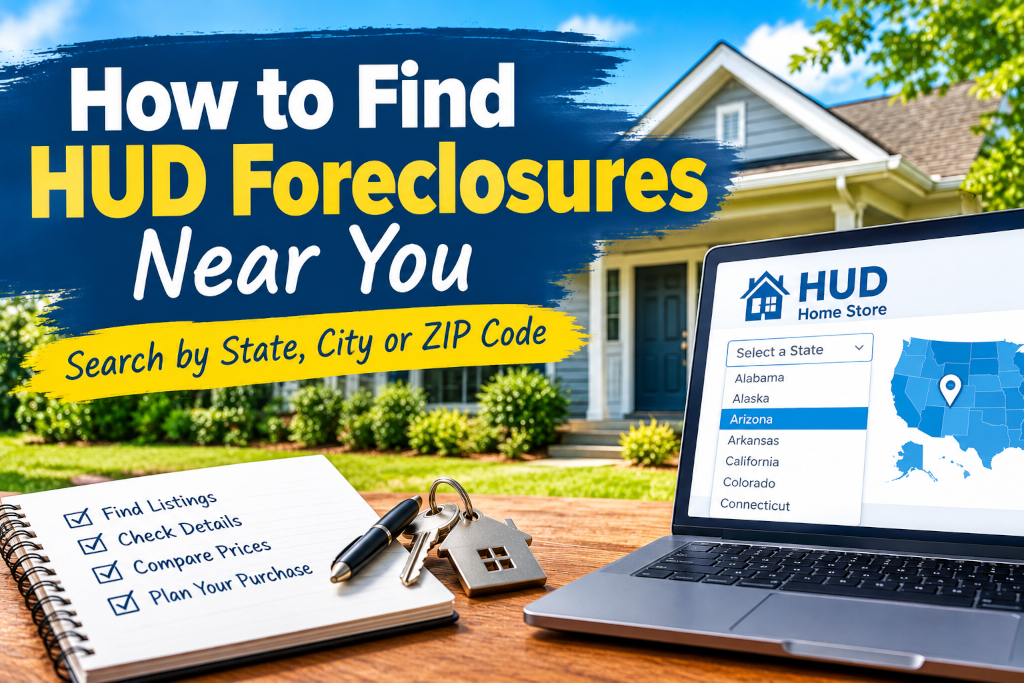
The official HUD Home Store will open in a new tab. Select your state on its map to view available properties.
The best place to begin is the official HUD Home Store.
This is HUD’s property listing portal, where prospective buyers can explore available HUD-owned homes and review the details associated with individual listings. You can begin with a state and narrow your search to a particular city or ZIP code.
HUD also explains its property sales process on its official How to Buy and Sell HUD Homes information page.
Why start with the official website?
Third-party real estate websites may provide useful information, but their listings and updates can differ. Starting with HUD Home Store helps you verify whether a property is currently listed through HUD’s sales process and review the applicable bidding instructions.
Keep in mind that availability changes, so confirm the status of any property that interests you.
Search HUD Foreclosures by State
If you want to find HUD homes in a particular state, start by selecting your location below. The search link will take you to the official HUD Home Store, where you can select your state and browse available properties.
Search the official HUD Home Store
You can use the state search tool on this page to get started, then narrow the results by city, ZIP code, price, and other available listing criteria.
How to Find HUD Homes by City or ZIP Code
Once you’ve opened the official HUD Home Store, narrow your search to the area where you want to buy.
1. Search by city
If you want to live in a particular city, search that location first. This can help you focus on properties close to your workplace, family, schools, or other important destinations.
2. Search by ZIP code
A ZIP code search can be useful if you want to focus on a particular neighborhood or a small geographic area.
You may also want to compare nearby ZIP codes. Expanding your search area can reveal properties you might otherwise overlook.
3. Compare different neighborhoods
Don’t evaluate a HUD home by its asking price alone. Compare properties in similar neighborhoods and consider local property values, taxes, insurance costs, commute times, and the condition of the surrounding area.
A less expensive property may not be the best choice if it requires major repairs or is located in an area that doesn’t suit your needs.
4. Check the listing details
Read the complete property listing before making any decisions. Look for the asking price, property type, current status, offer deadlines, eligibility requirements, and any special sales conditions.
If you have questions about a particular home, contact a real estate broker familiar with HUD transactions.
How to Evaluate a HUD Foreclosure Listing
Finding a property is only the beginning. The next step is deciding whether it’s worth pursuing.
Here are some important things to check.
Property condition
HUD homes are generally sold as-is. HUD does not guarantee the property’s condition or agree to repair defects before the sale.
Some homes may be in relatively good condition, while others may require substantial repairs.
Before submitting an offer, arrange a professional inspection to the extent permitted by the sales process. Pay particular attention to the roof, foundation, plumbing, electrical system, heating and cooling equipment, and evidence of water damage.
Asking price versus market value
Compare the asking price with recent sales of similar properties in the same area.
Consider the home’s size, age, condition, location, and estimated repair expenses. A low asking price does not necessarily mean the property is below market value once all costs are considered.
Financing requirements
Determine whether you intend to pay cash or obtain a mortgage.
A lender can help you understand your financing options and whether the property’s condition may affect loan approval. Homes requiring significant rehabilitation may warrant investigating an eligible FHA 203(k) rehabilitation mortgage.
Buyer eligibility and bidding deadlines
Some HUD properties have an initial priority period for eligible owner-occupants. Other listings may have special restrictions or requirements.
Review the current listing instructions to determine who may submit an offer and when bids must be received.
Can First-Time Homebuyers Purchase HUD Homes?
Yes. HUD homes can be an option for first-time homebuyers, provided they meet the applicable eligibility and financing requirements.
Some properties may be available during an owner-occupant priority period, giving eligible buyers purchasing a primary residence an opportunity to submit bids before broader bidding begins.
However, first-time buyers should be careful not to stretch their budgets simply because a property appears inexpensive.
Before making an offer, estimate your total costs, including the down payment, closing costs, inspection, repairs, insurance, property taxes, and ongoing maintenance.
You can learn more in our guide to HUD foreclosures and how to buy HUD homes.
Can Real Estate Investors Buy HUD Foreclosures?
Investors may be eligible to purchase HUD homes, but they must follow the applicable listing and bidding rules.
Some properties are initially offered to eligible owner-occupants before becoming available to investors. The timing and conditions depend on the individual listing.
If you’re buying a property to renovate and resell, or to rent out, calculate the full investment cost before submitting a bid.
Include acquisition expenses, repairs, financing, insurance, property taxes, maintenance, and likely selling or rental costs. A property that looks attractive on paper may not produce the return you expect.
Do You Need a Real Estate Agent to Buy a HUD Home?
HUD requires prospective buyers to work through a real estate broker registered to submit bids through HUD’s sales system.
A broker familiar with HUD properties can help you understand the listing, arrange a showing when permitted, prepare your offer, and comply with submission deadlines.
Before choosing a broker, ask whether they have experience with HUD transactions and whether they can explain the relevant bidding requirements.
You can also use the official HUD Home Store to find information about registered selling brokers.
Common Mistakes to Avoid When Searching for HUD Foreclosures
Searching for HUD homes can be straightforward, but a few mistakes can lead to unnecessary expense or disappointment.
Relying on outdated listings: Always verify current availability through the official listing process.
Focusing only on the asking price: Include repairs, closing costs, financing, insurance, and other expenses in your budget.
Skipping the inspection: A property may have defects that aren’t obvious in photographs or during a brief showing.
Ignoring bidding rules: Check the buyer eligibility requirements, bid deadlines, and other sales conditions.
Assuming every HUD home is a bargain: Compare the property with similar homes and calculate the total acquisition cost before deciding whether to proceed.
Sending money without verification: Confirm deposit instructions through trusted, independently verified contacts and follow the official sales terms.
Frequently Asked Questions About Finding HUD Foreclosures
Where is the best place to find HUD homes for sale?
Start with the official HUD Home Store. It provides listings of HUD-owned homes offered for sale through HUD’s property sales process.
Can I search for HUD foreclosures in my state?
Yes. Visit HUD Home Store and select the state you want to search. You can then narrow your search using available location and property filters.
Can I find HUD homes by ZIP code?
Yes. HUD Home Store supports location-based searches, including ZIP code searches. Search your preferred ZIP code and review the available listings and their individual sales terms.
Are all foreclosure homes listed on HUD Home Store?
No. HUD Home Store focuses on HUD-owned properties. Bank-owned homes, properties sold at foreclosure auctions, and properties owned by other agencies may be listed through different websites and sales processes.
Can I buy a HUD home without paying cash?
Potentially. Eligible buyers may use mortgage financing if the property and borrower meet the lender’s requirements. Speak with a lender before submitting an offer.
Are HUD homes always cheap?
No. Some may offer attractive value, while others may be priced in line with their current condition and local market. Compare similar properties and estimate repairs before making a decision.
Can I buy a HUD home as an investment property?
Potentially, yes. Investors must follow the applicable sales requirements, including any owner-occupant priority period or other restrictions on the individual listing.
Start Searching for HUD Foreclosures Near You
Finding a HUD foreclosure begins with knowing where to look. The official HUD Home Store lets you explore listings and narrow your search to the state, city, or ZIP code that interests you.
Once you find a property, take time to review its condition, compare prices, understand the bidding rules, and calculate the full cost of ownership. A careful search can help you identify opportunities without rushing into a purchase that doesn’t fit your budget.
Ready to begin? Visit the official HUD Home Store to search for available HUD homes.
Disclaimer: This article is for general educational purposes only and is not legal, mortgage, financial, or investment advice. Listing availability, bidding rules, and program requirements can change. Verify current information with HUD, a qualified real estate professional, and your lender before making a purchase.