

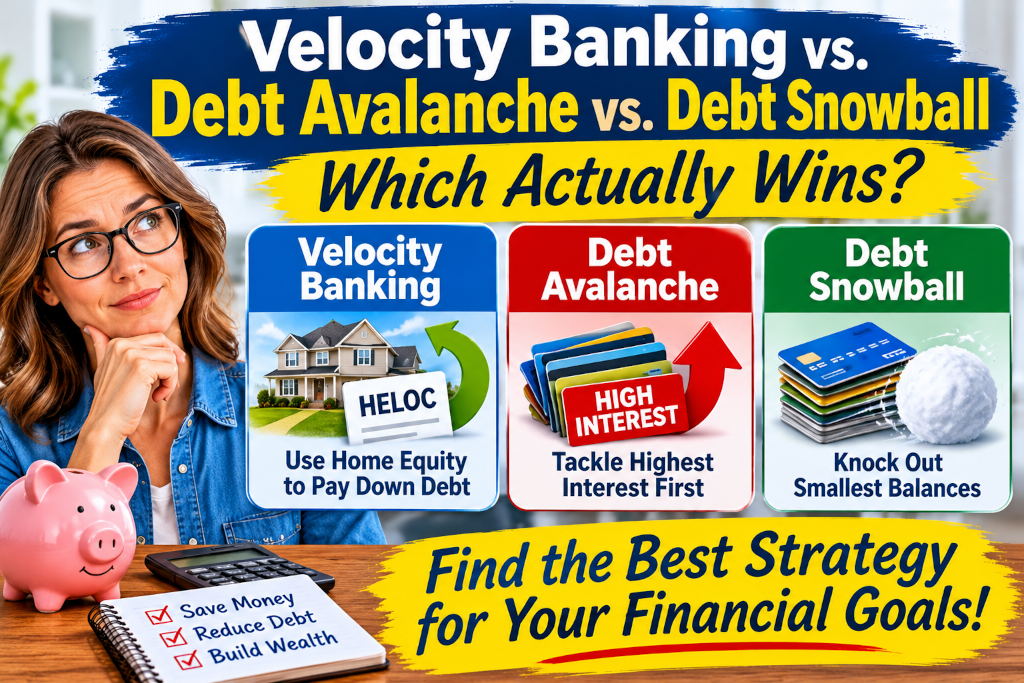
If you’re serious about getting out of debt, you’ve probably come across several strategies promising to help you become debt-free faster.
Some financial experts recommend the debt snowball. Others swear by the debt avalanche. And then there’s velocity banking, a strategy that has gained attention among homeowners who want to pay off their mortgage faster, reduce interest expenses, and potentially eliminate other debts along the way.
But which strategy actually works?
Is velocity banking really a shortcut to becoming debt-free? Does the debt avalanche save the most money? And is the debt snowball worth considering even if it might cost you more in interest?
The truth is that all three strategies can help you make progress, but they work differently, involve different levels of risk, and aren’t necessarily designed to solve the same financial problems.
In this guide, we’ll break down how each method works, examine the advantages and disadvantages, compare the financial considerations, and help you decide which strategy makes the most sense for your situation.
Let’s find out which one actually wins.
Understanding the Three Debt Payoff Strategies
Before comparing the methods, it’s important to understand what each one is designed to accomplish.
1. The Debt Snowball: Build Momentum by Paying Off Small Debts First
The debt snowball is one of the easiest debt repayment strategies to understand.
Instead of focusing on interest rates, you organize your debts from the smallest balance to the largest.
You continue making the minimum payments on every debt, but put any additional money toward the smallest balance.
Once that debt is paid off, you take the money you were paying toward it and add it to the payment on the next-smallest debt.
You repeat the process until all your debts are eliminated.
Example:
Imagine you have these four debts:
| Debt | Balance | Interest rate |
|---|---|---|
| Credit card A | $750 | 24% |
| Personal loan | $2,500 | 12% |
| Credit card B | $5,000 | 21% |
| Auto loan | $12,000 | 7% |
With the debt snowball, your repayment order would be:
- Credit card A: $750
- Personal loan: $2,500
- Credit card B: $5,000
- Auto loan: $12,000
Notice that the highest-interest debt isn’t necessarily paid first.
The goal is to eliminate smaller balances quickly so you can experience progress and build momentum.
Why people like it:
Paying off an entire account can be motivating. Instead of feeling like you’re throwing extra money into several large balances with little visible progress, you get to eliminate individual debts.
For people who struggle with consistency, that psychological reward can be valuable.
The downside:
You may pay more interest over time because you’re not necessarily attacking the most expensive debt first.
If a large credit card balance carries a 25% interest rate, allowing it to remain outstanding while you pay off a smaller debt at 8% could cost you money.
The snowball prioritizes motivation over interest-rate efficiency.
2. The Debt Avalanche: Save Money by Attacking High-Interest Debt First
The debt avalanche takes a different approach.
Instead of organizing debts by balance, you organize them by interest rate, from highest to lowest.
You make the minimum payments on all accounts and direct every available extra dollar toward the debt with the highest interest rate.
Once that balance is eliminated, you move to the next-highest interest rate.
You continue until all debts are paid.
Using the same example:
| Debt | Balance | Interest rate |
|---|---|---|
| Credit card A | $750 | 24% |
| Personal loan | $2,500 | 12% |
| Credit card B | $5,000 | 21% |
| Auto loan | $12,000 | 7% |
Your avalanche payoff order would be:
- Credit card A: 24%
- Credit card B: 21%
- Personal loan: 12%
- Auto loan: 7%
In this example, the first debt happens to be the same as the snowball method. However, the second and third priorities are different.
Why people like it:
The avalanche method generally minimizes the interest paid when comparing debts with the same repayment budget, assuming the interest rates and other loan terms remain unchanged.
You’re eliminating the most expensive debt first instead of allowing high-interest balances to continue accumulating charges.
That can mean more money stays in your pocket.
The downside:
Depending on your balances, it may take longer to eliminate your first account.
For someone who needs frequent signs of progress to stay motivated, the avalanche can feel discouraging.
However, if you can stay disciplined, it’s usually the more cost-effective strategy for paying off multiple debts.
The Consumer Financial Protection Bureau (CFPB) explains both the highest-interest-rate method and the snowball method in its debt reduction worksheet.
3. Velocity Banking: Use Cash Flow and a HELOC to Accelerate Debt Reduction
Velocity banking is different from the other two strategies.
Rather than simply deciding which debt to pay first, velocity banking typically uses a home equity line of credit (HELOC) as a financial tool to manage cash flow and make larger payments toward mortgage principal.
A HELOC allows a homeowner to borrow against available equity in their property. It functions as a revolving credit line, somewhat like a credit card, but the home serves as collateral.
The basic velocity banking concept involves using the HELOC to make a large principal payment toward an existing mortgage, then directing income into the HELOC to pay down the borrowed amount.
The process may be repeated as cash flow allows.
Some versions of the strategy also route paychecks and household expenses through the HELOC to reduce the average daily balance on which interest is calculated.
Here’s a simplified example of how it works.
Step 1: Obtain a HELOC.
You apply for a home equity line of credit based on your available equity, income, creditworthiness, and the lender’s requirements.
Step 2: Borrow a lump sum.
Suppose you have $20,000 available on your HELOC and decide to use it to make an additional principal payment on your mortgage.
Your mortgage principal is reduced by $20,000.
However, you now owe that $20,000 on the HELOC.
You haven’t eliminated the debt. You’ve moved it from one loan to another.
Step 3: Direct income toward the HELOC.
Your paycheck is deposited into the HELOC, reducing its outstanding balance.
You then pay your regular living expenses from your available funds or draw on the line as necessary, depending on the system you’re using.
The goal is to maintain positive cash flow so that the HELOC balance steadily declines.
Step 4: Repeat the process when financially appropriate.
Once you’ve paid down the HELOC enough to make another principal payment, you may repeat the cycle.
The idea is to reduce mortgage principal earlier while using disciplined cash flow management to repay the revolving credit line.
Why Does Velocity Banking Appeal to Homeowners?
Mortgage interest is generally calculated using an amortization schedule. During the earlier years of many long-term mortgages, a significant portion of each scheduled payment goes toward interest rather than principal.
Making additional principal payments can reduce the balance on which future mortgage interest is calculated.
A HELOC also generally calculates interest using the outstanding daily balance. Depositing income can temporarily reduce that balance and the interest accruing on it.
That sounds attractive, but there’s an important distinction:
The HELOC doesn’t make money disappear, and moving debt from a mortgage to a HELOC doesn’t automatically create savings.
The strategy’s success depends on cash flow, interest rates, fees, repayment timing, and the terms of both loans.
A homeowner who simply makes an extra $20,000 mortgage principal payment using available savings may achieve a similar mortgage-principal reduction without taking on a new HELOC balance.
That’s why the entire strategy needs to be evaluated—not just the size of the lump-sum payment.
Side-by-Side Comparison: Which Strategy Has the Advantage?
Here’s how the three methods compare.
| Feature | Debt Snowball | Debt Avalanche | Velocity Banking |
|---|---|---|---|
| Primary goal | Build motivation | Minimize interest | Accelerate principal reduction through cash flow and borrowing |
| Main tool | Budget and extra payments | Budget and extra payments | Usually a HELOC |
| First priority | Smallest balance | Highest interest rate | Depends on the HELOC and mortgage strategy |
| Requires home equity? | No | No | Usually yes |
| Requires new borrowing? | No | No | Yes, typically |
| Can work for renters? | Yes | Yes | Generally not in its traditional HELOC form |
| Interest savings | May be lower | Generally strongest mathematically for multiple debts | Depends on the full cost and structure |
| Complexity | Low | Low | Moderate to high |
| Home at risk through strategy? | No | No | Yes, because the HELOC is secured by the home |
| Best suited for | People who need motivation | People focused on minimizing interest | Qualified homeowners with strong cash flow and a carefully modeled plan |
The comparison reveals something important.
The snowball and avalanche are primarily debt-prioritization strategies. Velocity banking is a borrowing and cash-flow strategy.
That means velocity banking isn’t automatically better simply because it can move a large amount of mortgage principal at once.
You need to determine whether the additional borrowing costs and risks are justified by the potential savings.
The Math: Which Strategy Actually Saves the Most Money?
Let’s look at a practical example.
Imagine a household has the following debts:
| Debt | Balance | Interest rate |
|---|---|---|
| Credit card A | $4,000 | 25% |
| Credit card B | $8,000 | 21% |
| Personal loan | $10,000 | 12% |
| Mortgage | $250,000 | 6.5% |
The household has an additional $700 per month available after making all required minimum payments.
How should that extra money be used?
If You Choose the Debt Snowball
The order would be:
- Credit card A: $4,000
- Credit card B: $8,000
- Personal loan: $10,000
- Mortgage: $250,000
The household would focus on eliminating the smallest balance first, regardless of interest rate.
This can create early wins and simplify the household’s finances as accounts are eliminated.
If You Choose the Debt Avalanche
The order would be:
- Credit card A: 25%
- Credit card B: 21%
- Personal loan: 12%
- Mortgage: 6.5%
In this particular example, the first debt is the same under both strategies, but the avalanche prioritizes the remaining debts by their interest rates.
Because the credit cards have much higher rates than the mortgage, paying them down first is generally the most cost-effective use of the additional $700.
If You Choose Velocity Banking
A homeowner might consider using a HELOC to pay off or reduce the credit card balances, or to make a large payment toward mortgage principal.
But the numbers matter.
Suppose the homeowner can obtain a HELOC at 9%.
Moving $12,000 of credit card debt from rates of 21% and 25% to a 9% HELOC could reduce interest costs substantially, assuming the HELOC fees and repayment terms don’t erase the savings.
However, that debt is now secured by the home.
If the homeowner uses the HELOC to pay down the mortgage instead, the strategy must be evaluated against simply directing the same available cash toward the credit cards and then making additional mortgage payments.
The right comparison is not simply:
- Pay $20,000 toward the mortgage now, or
- Pay $20,000 toward the mortgage later.
It is:
- Compare the total interest, fees, payment timing, and risk of the HELOC strategy against the total cost of making the same extra payments without borrowing.
This distinction is essential.
The winner cannot be determined from the mortgage rate alone. You need to model the entire household debt structure and the actual cash flow available to repay the HELOC.
The Hidden Risks of Velocity Banking
Velocity banking is often presented as a clever way to eliminate debt faster, but there are several risks homeowners should understand before using it.
1. Your HELOC Interest Rate Can Change
Most HELOCs have variable interest rates.
That means the rate may increase or decrease based on the index and margin specified in your agreement.
If your HELOC rate increases significantly, the strategy may become less attractive.
For example, borrowing at 9% to reduce debt charging 22% may look appealing.
But borrowing at 11% to accelerate repayment of a mortgage charging 6.5% requires a much more careful analysis.
You should never assume today’s HELOC rate will remain unchanged throughout the strategy.
2. You’re Putting Your Home at Risk
This is perhaps the most important consideration.
A HELOC is generally secured by your home.
If you cannot make the required payments, the lender may have the right to pursue foreclosure, subject to applicable law and the loan agreement.
Compare that with the debt snowball or avalanche.
If you use either method to pay down unsecured credit-card debt, you’re not pledging your home as collateral for the repayment strategy.
Moving unsecured debt onto a HELOC may reduce the interest rate, but it also changes the consequences of default.
That’s a serious trade-off.
3. Your Income Must Consistently Exceed Your Expenses
Velocity banking depends heavily on positive cash flow.
If you earn $6,000 per month but spend $5,900, you have very little room to reduce your debt.
If your income is irregular, commission-based, seasonal, or unpredictable, the strategy becomes more difficult to manage.
A job loss, medical emergency, unexpected home repair, or other financial disruption can quickly change the numbers.
4. HELOC Fees and Restrictions Can Reduce Savings
Depending on the lender and agreement, a HELOC may involve:
- Application fees.
- Appraisal fees.
- Closing costs.
- Annual fees.
- Early termination fees.
- Variable interest rates.
- Minimum payment requirements.
- Restrictions on borrowing or available credit.
Lenders may also reduce or suspend access to additional credit under certain circumstances permitted by the agreement and applicable law.
The Consumer Financial Protection Bureau explains these considerations in its official HELOC guide.
5. Cash Flow Management Requires Discipline
Some velocity banking systems encourage homeowners to route virtually all income and household expenses through the HELOC.
This requires careful tracking.
If you don’t understand your cash flow or regularly spend more than you earn, the HELOC can become another source of accumulating debt rather than a tool for reducing it.
Velocity banking is not a substitute for budgeting.
When the Debt Snowball Makes the Most Sense
The snowball method may be the best choice if:
- You have several smaller debts.
- You feel overwhelmed by the number of accounts you owe.
- You’ve struggled to stay consistent with a repayment plan.
- You need to see early results to stay motivated.
- You don’t own a home or don’t want to borrow against your equity.
- You prefer a simple approach without opening additional accounts.
There’s nothing wrong with choosing a strategy that helps you stick with your financial goals.
A mathematically optimal strategy isn’t useful if you abandon it after two months.
If eliminating smaller balances gives you the motivation to keep going, the snowball may be a practical choice.
Just understand that it can cost more in interest than the avalanche.
When the Debt Avalanche Makes the Most Sense
The avalanche method is generally the strongest choice if your primary goal is minimizing interest expenses.
Consider it if:
- You have multiple credit cards or loans.
- Some of your debts carry very high interest rates.
- You have enough income to make extra payments.
- You’re comfortable waiting longer to eliminate larger accounts.
- You want to avoid taking on additional debt.
- You don’t want to put your home at risk.
For people with high-interest credit-card debt, the avalanche can be especially valuable.
Paying down a balance charging 25% interest is generally a better use of extra money than making additional payments toward a mortgage charging 6.5%, assuming there are no unusual loan terms or other considerations.
Once the high-interest debt is gone, you can redirect those payments toward lower-rate debts and eventually your mortgage.
When Velocity Banking Might Make Sense
Velocity banking may be worth investigating if:
- You own a home with substantial available equity.
- Your income is consistent.
- You regularly have meaningful positive cash flow.
- You understand how HELOC interest is calculated.
- You have compared the HELOC rate, fees, and repayment requirements with your existing debt costs.
- You can comfortably handle the payments if interest rates increase.
- You maintain an emergency fund outside the HELOC.
- You understand that your home is collateral.
It may be particularly worth analyzing when a homeowner has high-interest unsecured debt and can replace it with a lower-cost borrowing option.
However, that doesn’t mean a HELOC is automatically the best solution.
A personal loan, balance transfer, or direct avalanche repayment plan may be more appropriate depending on the interest rates, fees, and risks.
If you’re considering velocity banking, have a qualified financial professional review the numbers before putting your home equity on the line.
Could You Combine the Strategies?
Absolutely.
In fact, combining elements of these methods may be the most practical approach for some households.
For example, imagine you have:
- Three credit cards.
- A personal loan.
- A car payment.
- A mortgage.
You could use the debt avalanche to prioritize the highest-interest debts while using the snowball concept to build momentum when two debts have similar rates.
Once the expensive consumer debt is eliminated, you could focus on paying down your mortgage.
If you’re a homeowner with substantial equity and strong cash flow, you could separately evaluate whether a HELOC offers a genuine financial advantage.
The important thing is not to use a financial strategy simply because it has a catchy name.
Use the parts that improve your financial position, and avoid the parts that introduce unnecessary risk.
A Simple Decision Guide: Which Strategy Should You Choose?
Here’s a straightforward way to think about it.
| Your financial situation | Strategy worth considering |
|---|---|
| You have several small debts and need motivation | Debt Snowball |
| You have high-interest credit-card balances | Debt Avalanche |
| You want to avoid taking on additional borrowing | Debt Avalanche or Snowball |
| You own a home with substantial equity and strong cash flow | Evaluate Velocity Banking carefully |
| Your income is irregular | Debt Avalanche or Snowball |
| You are uncomfortable using your home as collateral | Debt Avalanche or Snowball |
| You want a simple plan you can start immediately | Debt Avalanche or Snowball |
You don’t need a complicated financial system to get out of debt.
You need a realistic plan, consistent payments, and the discipline to avoid accumulating new balances while paying off existing ones.
Frequently Asked Questions
Is velocity banking better than the debt avalanche?
Not automatically. The avalanche is a straightforward way to minimize interest on multiple debts without borrowing additional money. Velocity banking may offer advantages in certain cash-flow and interest-rate situations, but its HELOC costs and risks must be included in the calculation.
Does velocity banking really work?
It can reduce mortgage interest under suitable conditions, particularly when a homeowner has positive cash flow and manages a HELOC effectively. However, it is not a guaranteed shortcut to becoming debt-free. Results depend on the interest rates, loan terms, fees, repayment discipline, and cash flow.
Does the debt avalanche always save more money?
When comparing the snowball and avalanche methods with the same debts, interest rates, payment budget, and other loan terms, the avalanche generally minimizes total interest by targeting the highest-rate balance first.
Actual results can differ if rates change, fees apply, or loan terms introduce other considerations.
Is the debt snowball a bad financial decision?
Not necessarily. Although it may cost more in interest, it can help people build momentum and stay committed to a repayment plan. Consistency matters, and the best strategy is one you can realistically maintain.
Can you use velocity banking without owning a home?
Traditional velocity banking generally relies on a HELOC, so it usually requires homeownership and sufficient available equity. Some people use other credit products to manage cash flow, but those approaches have different costs and risks and should not automatically be considered equivalent to a HELOC strategy.
Should I use a HELOC to pay off credit cards?
It may make sense in certain situations if the HELOC’s total borrowing cost is substantially lower than the credit-card rates and you have a reliable repayment plan.
However, you’re converting unsecured debt into debt secured by your home. If you fall behind, your home could be at risk. Compare alternatives carefully before making that decision.
Final Verdict: Which Debt Payoff Strategy Actually Wins?
So, after comparing velocity banking, the debt avalanche, and the debt snowball, which one comes out on top?
The answer depends on what you’re trying to accomplish.
The debt avalanche wins on interest-rate efficiency.
If your goal is to pay off multiple debts while minimizing the interest you pay, targeting the highest-interest balance first is generally the strongest mathematical approach.
The debt snowball wins on motivation for many people.
If you’re overwhelmed by debt and need early victories to stay committed, eliminating smaller balances first can help you build momentum.
Velocity banking may be useful for certain homeowners, but it comes with additional complexity and risk.
It can be worth evaluating when you have substantial home equity, reliable positive cash flow, and favorable borrowing terms. But the strategy does not eliminate debt simply by moving it from one account to another, and using your home as collateral raises the stakes.
For most households trying to eliminate credit-card balances, personal loans, and other consumer debt, I would start with the debt avalanche—or use the snowball if motivation is the bigger obstacle.
Once high-interest debt is under control, you can focus on your mortgage and other long-term financial goals.
The most important lesson is this:
You don’t need a secret banking trick to become debt-free. You need to spend less than you earn, direct your extra money toward debt consistently, and avoid creating new debt while you’re paying off the old.
The strategy matters, but the financial habits behind it matter even more.
Disclaimer: This article is for educational purposes only and is not financial, tax, mortgage, or legal advice. HELOC terms, interest rates, fees, and borrower protections vary by lender and location. Consult qualified financial and lending professionals before using home equity to pay off debt.
